
Managing Freight Spend with Gateway for D365
- Dec 11, 2025
- 5 min read
Shipping gaps within standard D365 Supply Chain Management (SCM)
In today’s logistics-driven economy, freight costs don’t just impact your bottom line, they're the driving force behind your business' pricing decisions (and customer satisfaction). For organizations relying on Microsoft Dynamics 365 Finance & Supply Chain Management (SCM), freight charge data typically comes from outside the system, making it hard to synchronize costs, validate charges, and forecast spend accurately. The result: Hidden financial leakage, delayed settlements, and frustration between your logistics and finance teams.
According to a 2017 survey by the Global Supply Chain Council, 61% of supply chain professionals said that invoice matching was the most challenging process in their accounts payable department. The survey also found that 63% of respondents experienced invoice matching errors due to discrepancies between purchase orders and invoices. Additionally, the survey reported that only 21% of respondents had a fully automated invoice matching process within their organization.
Today, the role of a supply chain operator extends far beyond procurement and delivery management. It often involves finding the best carrier rates and services while reconciling freight invoices to ensure alignment with corporate financial goals. The problem is that you need your carrier's financials to sync up with your D365 SCM system.
Reconciling invoices using standard D365

Without an integrated D365 shipping solution, the process of reconciling carrier freight invoices becomes entirely manual.
Freight rates are calculated by a rate engine linked to a shipping carrier, generating a freight bill upon confirmation of the load. These rates are allocated to source documents like purchase, sales, or transfer orders. The reconciliation process starts once a carrier invoice is received (either electronically or on paper).
The reconciliation and accrual process requires manually uploading shipment invoice files and creating vendor invoice journals, debiting and crediting each transaction accordingly, using standard financial processes within D365 SCM.

It's an essential process that produces accurate billing and allocation of freight charges; however, for shippers, the functional gaps as obvious:
 | Carrier invoice files must be manually uploaded, requiring manual data entry for every transaction across multiple screens. For medium-sized supply chain operations, this could equate to thousands of entries per month. |
 | The system cannot determine expected charges (including freight, fuel, handling etc.) without the implementation of a shipping carrier rate engine. |
 | All invoices need to be addressed manually, regardless of whether or not the totals align with expected charges received from the carrier. |
 | There are no carrier-specific parameters or tolerance rules for defining how expected invoice charges will be compared, approved, or rejected. |
How NMB's Carrier Invoice Reconciliation module bridges the gap
NMB Gateway for Parcel’s Carrier Invoice Reconciliation module (CIRS) is designed to automate the entire freight invoice reconciliation process. By leveraging native D365 batch job functionality, our enhanced module automatically uploads carrier invoice files for carrier services, consolidating invoice records onto a single screen where you can view invoice statuses, amounts, vendor account information and more. The module includes several key parameters designed to help your organization automate the entire reconciliation process—effectively syncing your D365 finances with your carrier account totals.

Using our integrated rate engine allows D365 SCM to calculate and project expected freight charges, which can be compared against the actual invoice totals received from the carrier (including amounts such as additional handling fees and fuel surcharges). You can also define discrepancy tolerance rules, which are used to auto-approve or auto-reject invoice amounts that differ from the expected charge amounts for each shipment or line tracking number (or both). It gives you a centralized module to investigate and mitigate overcharging discrepancies based on charge comparisons and tolerances.
In short, integrating NMB Gateway for Parcel's CIRS module with D365 SCM simplifies the freight invoice reconciliation process, reducing manual effort, errors, and processing time by seamlessly integrating with D365’s native financial modules. It provides real-time visibility into freight charges, ensuring accuracy through automated matching, and simplifies discrepancy resolution.
NMB Rate Shopping?
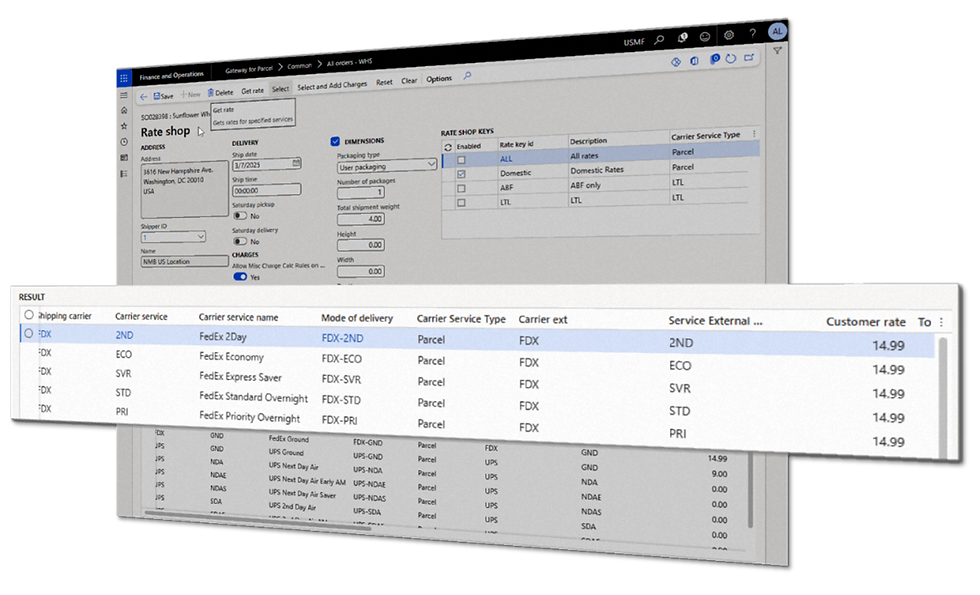
Without a third-party shipping engine, the standard D365 SCM system can’t support dynamic carrier rate calculations, contract rate management, or automatic updates based on real-time carrier APIs, leading to outdated or inaccurate shipping costs. Unpredictable rates complicate budgeting and financial planning, making it nearly impossible to manage freight expenses effectively.
NMB's Gateway for Parcel solution seamlessly connects with a dynamic rate shopping engine that automatically selects the best rates and services to meet delivery timeframes and reduce costs, enabling proactive communication with customers and improved delivery performance.
What about using a TMS?
Controlling freight spend isn’t just about negotiating good rates; it’s about ensuring those savings actually show up in your D365 SCM financials. For many shippers, a Transportation Management System (TMS) provides a clear solution: streamlining the planning, recording, and validation of freight costs through an external system. A TMS applies contracted rate logic and routing guides to help you pick the most cost-effective carrier and service every time. It means more accurate landed cost estimates and fewer surprises when invoices arrive.
While a TMS is excellent for capturing and controlling freight spend, that valuable data can get lost if it isn’t tracked within your D365 SCM financial systems.
A typical TMS is capable of:
Applying contract rate logic and real-time carrier pricing to make smarter shipping decisions.
Capturing all in-transit cost events—such as fuel surcharges, accessorial fees, re-routes, re-weighs, and unexpected charges—to create an accurate source of truth for freight costs.
Accurately accrues and allocates freight costs by posting to the correct order or cost center and applying line-item allocation rules—ensuring clean, timely period closes and giving finance confidence in accruals and margins.
As shipments move, the TMS becomes a source of truth for freight charges, but without the right D365-TMS connections, many shippers face delayed accruals and inconsistencies between what the TMS says they spent and what finance sees in D365 SCM.
How NMB prevents D365-TMS financial holes

NMB's Gateway for TMS solution makes that connection: bridging the financial gap to a TMS so your carrier freight charge information gets automatically integrated into your D365 SCM system.
Our solution facilitates accrual posting in D365 SCM for every TMS shipment based on predefined rules, allowing total shipment costs to be accrued per shipment (distributed by item weight, quantity, or number of items) and posted to a specified ledger account and the Financial dimensions of the item. This allows item accruals to be recorded in the General Ledger accounts in D365 SCM until an actual invoice is received from the shipping carrier.
It's just another example of how our solutions are built to enhance financial accuracy within D365 SCM; improving operational efficiency, leading to better, faster decision-making by:
 | Improving real-time financial visibility: automated financial data importing gives your organization up-to-date cost projections, allowing your financial teams to monitor budget vs. actual spend, preventing unexpected losses. |
 | Scalability and automation: eliminate manual spreadsheets and email-based processes. Our solution supports high-volume transactions across multiple legal entities, making it ideal for growing your business. |
 | Improved cost control and forecasting: accrual data provides insight into future liabilities. |
The gaps in standard D365 SCM make accurate freight accounting harder than ever—especially when critical cost data comes from external carriers or a TMS. Manual uploads, missing rate logic, and disconnected financial records leave shippers exposed to errors, delays, and hidden spend. By automating reconciliation, integrating real-time carrier charges, and bridging TMS cost data directly into D365, NMB’s solutions close these financial blind spots. The result is a streamlined, transparent, and fully-connected freight financial process that empowers teams to make faster, smarter, and more confident decisions.
Explore what’s new. Optimize what’s next. Let’s ship smarter—together.
Want to learn more?
Contact our Sales team today to find out how we can help you boost visibility, increase flexibility, and drive operational excellence with NMB Gateway for Parcel.



Comments